
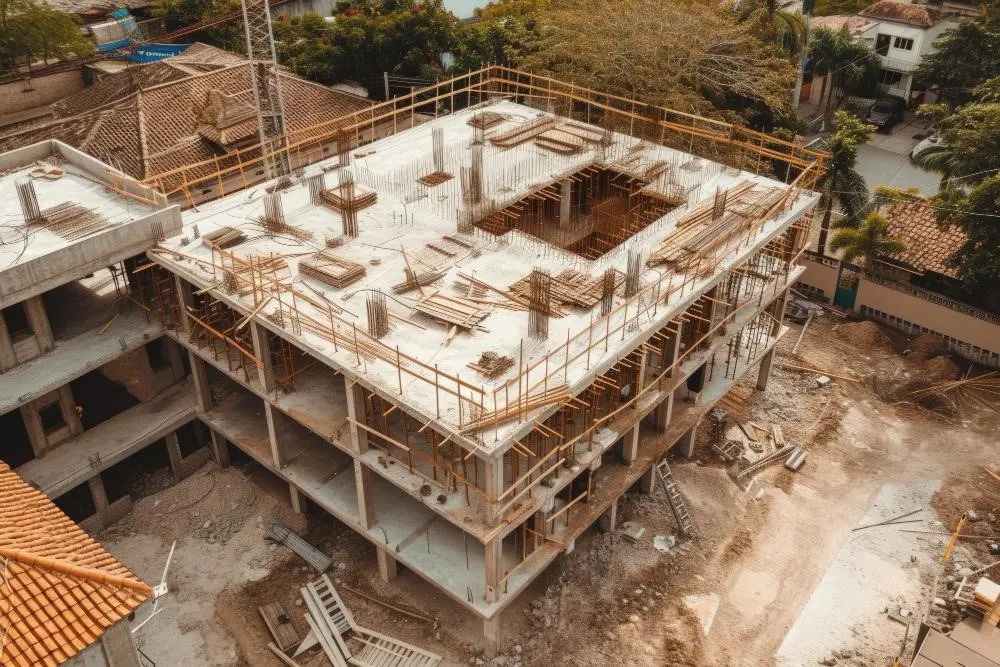
RCC (Reinforced Cement Concrete) buildings have become the standard for durability and strength in modern construction. This method combines the best of both worlds concrete’s strength in handling compression and steel’s resilience in handling tension.
RCC buildings are widely used, from homes to large commercial complexes. They support heavy loads and resist many environmental stresses. Understanding the role of RCC in construction helps explain why it remains a cornerstone of structural design today.
What is RCC Building?
Reinforced Cement Concrete (RCC) is a popular construction method used to create strong and durable structures. For those wondering what RCC is in construction, it is a composite material. It combines concrete with steel reinforcement bars (rebar).
The RCC full form is Reinforced Cement Concrete. This blend improves both materials, making RCC construction ideal for buildings needing strength and flexibility.
Concrete alone is excellent at handling compression forces, which means it can support heavy loads without crumbling. However, it is not as effective at handling tension forces, which can cause cracking. This is where steel reinforcement becomes essential. Steel bars provide the tensile strength needed to resist pulling forces, making the structure more resilient and durable.
The RCC definition captures this synergy: a composite material that leverages the strengths of both concrete and steel. By embedding steel rebar in concrete, RCC buildings balance strength and flexibility, helping them withstand many stresses and loads. This method is a key part of modern construction because it helps build safe, stable, long-lasting structures.
Types of RCC in Modern House Construction
Here are three commonly used types of reinforced concrete:
-
Fiber-Reinforced Concrete (FRC)
This concrete includes various fibers such as steel, mineral, and organic fibers. FRC enhances tensile strength and reduces costs compared to traditional steel reinforcement. People often use it in flooring and pavements to improve crack resistance and durability.
-
Polymer Concrete
Instead of cement binders, polymer concrete uses polymer binders, offering greater strength, adhesion, and resistance to chemicals and abrasion. It sets through polymerization at ambient temperatures, making it ideal for high-performance applications such as industrial flooring.
-
Ferrocement Concrete
Created using wire meshes and strong cement mortar, ferrocement is lightweight, versatile, and moldable into various shapes. It is cost-effective and durable, making it suitable for curved roofs and water tanks. It also offers improved earthquake resistance.
How RCC Transforms Modern Construction
RCC is central to the success of modern house construction and a wide range of infrastructure projects. Its unique properties make it essential for creating durable and long-lasting buildings.
Strength Meets Flexibility
RCC construction combines the compressive strength of concrete with the tensile strength of steel reinforcement. Concrete alone may crack under tension, but with steel reinforcement, structures can withstand various stresses without compromising strength.Enduring Performance in Modern House Construction
In modern house construction, RCC provides long-term stability and performance. Its resistance to weathering, wear, and structural fatigue makes it ideal for residential buildings. Its strength also allows for larger open spaces, as it supports heavy loads with fewer columns and supports.
Versatility Across Various Applications
RCC construction is not limited to residential buildings. It is widely used in bridges, highways, flyovers, dams, and tall buildings.
This is because it adapts to many engineering needs and design styles.
The Cost-Effective Dynamo
Cost efficiency is another major advantage of RCC construction. By using common materials like cement, sand, aggregates, and steel reinforcement, RCC delivers strong performance at a reasonable cost. This makes quality construction accessible for both small residential and large commercial projects.
Safety and Security
RCC buildings provide excellent fire resistance and high load-bearing capacity. These properties significantly enhance the safety of occupants and improve the overall structural reliability of buildings.
Expert Involvement in RCC Construction
Choosing the right construction partner is essential for achieving quality results in RCC construction projects. One trusted name is GharEka. It is known as India’s best construction company. It is backed by the Shyam Steel Group.
GharEka offers a full range of services. These include house plan design and project execution. They also cover approval management and material sourcing. Their experienced team ensures that every project meets high quality standards while remaining cost-efficient.
What truly sets GharEka apart is its commitment to transparency and real-time updates. Through our mobile app, clients can track progress at every stage of construction. This ensures clarity and confidence throughout the home-building journey. With strong experience in top residential projects nationwide, GharEka keeps raising standards in RCC construction.
Also Read: Modern House Plans for Compact Urban SpacesGain Further Insights into RCC Construction
There is no difference. RCC (Reinforced Cement Concrete) is simply another name for reinforced concrete, which is concrete strengthened with steel bars or mesh to improve its strength and durability.
RCC is a construction material made by combining cement, sand, aggregates, water, and steel reinforcement. The steel provides tensile strength while the concrete provides compressive strength, making the structure strong and stable.
RCC is widely used in foundations, columns, beams, slabs, staircases, and roofs because it provides strong structural support and long-term durability.
A common RCC mix ratio used in residential construction is 1:2:4, which means 1 part cement, 2 parts sand, and 4 parts aggregates, along with water.
The thickness of an RCC slab usually ranges between 100 mm to 150 mm (4 to 6 inches) in residential buildings, depending on the design, load, and span of the slab.